
- All
- Product Name
- Product Keyword
- Product Model
- Product Summary
- Product Description
- Multi Field Search
Views: 0 Author: Site Editor Publish Time: 2026-06-18 Origin: Site


Your production relies on permanent, high-contrast marks to meet strict industry traceability standards. However, optical processing is not magic. The decision relies entirely on material absorption rates, production speed requirements, and specific thermal tolerances. You cannot force a single wavelength to process every substrate perfectly. Using mismatched technology inevitably destroys delicate parts, shatters glass, or melts engineered plastics. We provide a detailed technical comparison of the three primary industrial wavelengths to guide you through this process. You will discover exactly how each technology interacts with various complex materials. This comprehensive guide equips you with the exact knowledge needed to make a scalable, highly confident purchasing decision.
Fiber Lasers (1064 nm): The industrial standard for direct part marking on metals and rigid plastics. Highest durability and lowest maintenance.
CO2 Lasers (10,600 nm): The most cost-effective solution for high-speed marking on organic materials (wood, paper, glass, rubber).
UV Lasers (355 nm): Photochemical "cold marking" designed for heat-sensitive, delicate, or highly reflective substrates (medical devices, microchips, gemstones).
Manufacturers often seek a universal tool to streamline their operations. Unfortunately, a universal laser marking machine does not exist in modern manufacturing. The core operational difference lies in foundational optical physics. Success depends strictly on how a specific material absorbs a specific wavelength of light. Every substrate reacts differently across the electromagnetic spectrum. You must match the light frequency directly to the material's unique absorption profile to achieve high-contrast results.
Consider the fundamental difference between thermal ablation and cold ablation. Fiber and CO2 systems rely heavily on thermal processes. They focus intense localized heat onto the part surface to create a visible mark. This intense heat melts, vaporizes, or oxidizes the very top layer of the material. The thermal process works exceptionally well for durable metals and thick, dense organics.
Conversely, ultraviolet systems utilize cold ablation. They deploy a photochemical process instead of relying on pure heat generation. High-energy photons directly break the molecular bonds of the substrate. This prevents surrounding areas from experiencing unwanted thermal stress or warping.
Note: Using a high-heat thermal laser on delicate substrates causes severe damage. It creates micro-fracturing and localized melting. This destroys part integrity and violates strict compliance standards. We frequently see manufacturers ruin delicate aerospace polymers by applying inappropriate thermal optics.
Let us examine the fiber laser marking machine. Engineers universally recognize it as the heavyweight champion for industrial tracebility. It operates at an infrared wavelength of 1064 nm. Metals readily absorb this specific optical frequency, allowing for extremely fast, permanent engraving.
Optimal materials include all grades of steel, aluminum, titanium, and brass. You can also process highly rigid engineered plastics effectively. We strongly recommend this solid-state technology for heavy-industrial environments.
Primary use cases span multiple demanding manufacturing sectors. Automotive plants rely on it for structural part identification. Aerospace manufacturers use it to guarantee component traceability under AS9100 standards. You will commonly see operators engraving durable barcodes, 2D Data Matrix codes, and permanent serial numbers. Tool manufacturers also engrave depth-specific specifications directly into hardened steel drill bits.
Operational advantages stand out clearly compared to older technologies:
Solid-state technology completely eliminates moving parts within the main optical cavity.
You face virtually zero consumable requirements during routine daily operations.
Industrial units routinely deliver an operating lifespan exceeding 100,000 hours.
Beam delivery remains perfectly stable across multi-shift production schedules.
Consider MOPA technology for your advanced surface applications. MOPA stands for Master Oscillator Power Amplifier. This advanced sub-type offers distinct advantages over traditional Q-switched models. You gain precise control over pulse durations. Adjustable pulse widths enable high-contrast black marks on anodized aluminum. You can even achieve vibrant, aesthetic color marks on stainless steel surfaces.
Tip: If your primary goal involves high-speed, permanent metal traceability with zero ongoing consumable replacements, a fiber laser is the most efficient choice available.

A CO2 laser marking machine generates light at 10,600 nm. This far-infrared wavelength behaves entirely differently than solid-state optics. Organics absorb this specific frequency with incredible efficiency, making it an industrial staple.
Optimal materials encompass a wide variety of non-metals. You can easily process wood, paper, cardboard, glass, and clear acrylic. Leather, natural fabrics, and industrial rubber also yield excellent results under this specific wavelength.
Primary use cases dominate the global packaging industry. Food and beverage production lines rely heavily on this technology for date coding. Pharmaceutical companies use them to stamp expiration details on paper cartons. You will also find them manufacturing numerous non-metal consumer goods, from custom wood crafts to engraved leather upholstery.
Let us review the operational advantages. These systems deliver exceptional speed for continuous, automated processing. Engineers integrate them directly into fast-moving production lines. They excel at "on-the-fly" processing where products never stop moving down the conveyor. High-wattage models easily process tens of thousands of bottles per hour without missing a single code.
However, you must acknowledge the specific implementation risks. These units utilize sealed glass tubes filled with specialized gas mixtures. The active gases slowly deplete over years of heavy usage. You will eventually require tube replacements or professional gas refilling services. Furthermore, beam delivery optics need regular maintenance. Dusty environments, like woodshops or cardboard plants, demand strict lens cleaning routines. Neglecting optic cleanliness causes rapid beam degradation.
Matching the correct laser wavelength to your material ensures permanent, high-contrast traceability while preventing structural damage.

The uv laser marking machine operates at an ultra-short 355 nm wavelength. We refer to this specialized technique as "cold marking." It represents the absolute pinnacle of industrial processing precision.
Optimal materials require highly careful handling. This sensitive category includes fragile glass, precious gemstones, silicon wafers, and printed circuit boards (PCBs). Heat-sensitive medical-grade plastics (like HDPE and PEEK) absolutely require this gentle optical touch.
Primary use cases focus on strict regulatory and compliance environments. The medical industry relies heavily on them for UDI (Unique Device Identification) compliance. UDI mandates permanent tracking numbers on implantable surgical devices. You cannot risk surface degradation, rusting, or bacterial harboring on medical implants. Semiconductor plants use them for microchip tracking. Jewelers rely on them for defect-free gemstone authentication.
Operational advantages center on extreme accuracy and material safety. The 355 nm frequency produces an extremely small focused spot size. This allows for microscopic character generation on tiny electronic components. More importantly, it essentially eliminates Heat-Affected Zones (HAZ). You completely prevent localized burning, micro-cracking, soot generation, or material deformation.
Note: Ultraviolet systems typically feature a highly complex internal optical architecture. The specific diode crystals experience gradual degradation over time. They have a shorter operational lifespan compared to solid-state alternatives. You should view them as a highly specialized engineering investment rather than a general-purpose workshop tool.
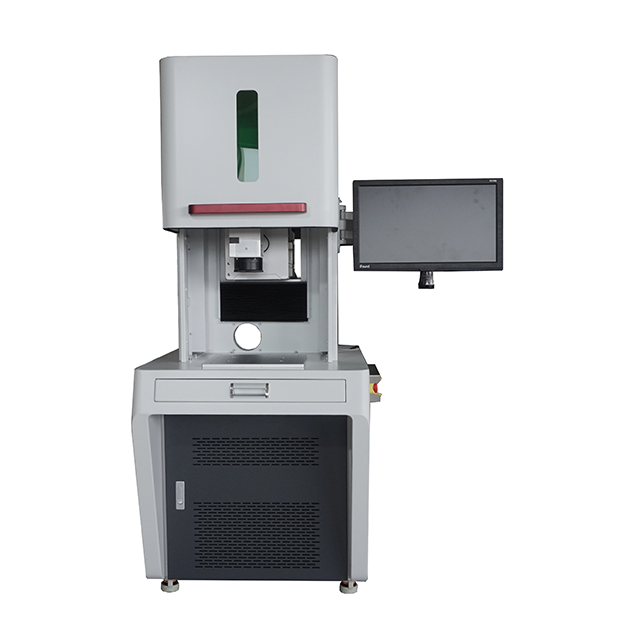
Creating a structured evaluation process prevents major equipment deployment failures. We created a comparative framework mapping common materials to specific optical types. Consult this matrix carefully before finalizing any equipment specifications for your facility.
You should follow these exact steps when consulting the matrix:
Identify the primary substrate material in your current production run.
Determine any secondary or future materials you might need to process.
Assess your industry's specific tolerance for thermal damage or micro-fracturing.
Select the equipment that provides the highest rating for your exact substrate.
Material Category | Fiber (1064 nm) | CO2 (10,600 nm) | UV (355 nm) |
|---|---|---|---|
Metals (Steel, Aluminum, Brass) | Excellent: Deep engraving, high contrast, fast cycle times. | Poor: Requires specialized, messy chemical marking sprays. | Good: High precision, but significantly slower processing speeds. |
Plastics (Engineered, Medical, ABS) | Good: Works well for hard plastics, though contrast varies. | Variable: High risk of edge melting or aggressive foaming. | Excellent: Flawless high contrast, zero thermal degradation. |
Organics (Wood, Paper, Leather) | Poor: Burns the material excessively or causes localized fires. | Excellent: Fast, clean ablation with perfect natural contrast. | Good: Works safely, but represents massive engineering overkill. |
Glass (Bottles, Displays, Labware) | Poor: Instantly shatters or micro-fractures the substrate. | Excellent: Creates a beautiful, deep frosted aesthetic finish. | Excellent: Perfect for micro-precision codes with zero cracking. |
You must isolate your exact material requirements before browsing technical catalogs. We highly recommend applying a simple, three-part shortlisting logic to guide your team. Choose solid-state infrared technology for unmatched metal durability and high production volumes. Choose far-infrared gas technology for organic materials and high-speed packaging lines. Choose ultraviolet cold-ablation technology for zero-damage, high-precision processing on sensitive components.
Do not guess your material's specific absorption rate. Always demand empirical physical data. As your immediate next step, we strongly recommend requesting sample material testing from your chosen vendor. Ask reputable manufacturers to perform a comprehensive Proof of Concept on your actual production parts. Evaluate the resulting visual contrast, machine cycle times, and microscopic structural integrity before finalizing your equipment purchase.
A: Yes, but with severe operational limitations. High-wattage models can cut exceptionally thin metal foils. However, these machines are specifically optimized for surface ablation, not structural cutting. They lack the assist gas integration and specific optic focal lengths required for clean, thick metal processing. You should purchase dedicated cutting equipment for heavy fabrication.
A: Absolutely. Many medical devices and aerospace plastics face strict regulatory compliance standards. Thermal degradation from standard infrared optics violates these safety protocols. The 355 nm photochemical process guarantees zero heat damage. If your industry mandates flawless structural integrity and zero micro-cracking, this specialized technology becomes entirely mandatory.
A: Standard models utilize a fixed Q-switched pulse duration. A MOPA (Master Oscillator Power Amplifier) architecture allows operators complete control over the pulse duration. You gain significantly finer control over localized heat input. This adjustability produces higher contrast marks, flawless black finishes on anodized aluminum, and specialized aesthetic color finishes on stainless steel.


