
- All
- Product Name
- Product Keyword
- Product Model
- Product Summary
- Product Description
- Multi Field Search



| Quantity: | |
|---|---|
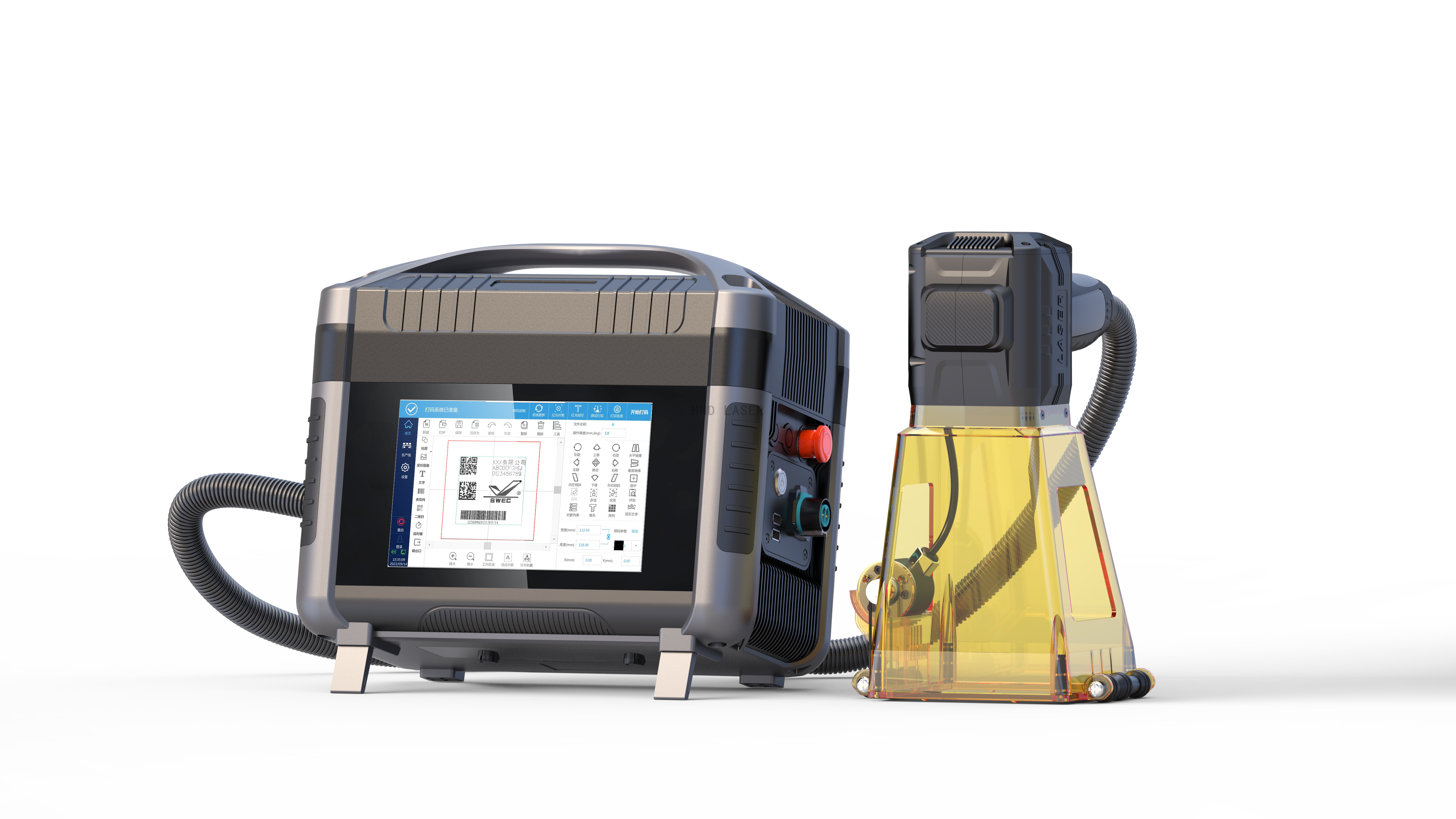
Portable and easy to move
Suitable for metal and some plastics
Fast and precise marking
Ideal for large or fixed workpieces
Supports text, logo, QR code, and serial number marking
Low maintenance and no consumables
Permanent marking with clear results
HF1000
HND LASER


Laser Power: 20W / 30W / 50W
Marking Area: 70×70 / 100×100 / 150×150 mm
Materials: Stainless Steel, Aluminum, Brass, Carbon Steel, Titanium
Mobility: Portable Handheld Design, Optional Built-in Battery
Use Cases: QR Code, Serial Number, Logo, Nameplate, Traceability
Service: Sample Marking / OEM / ODM Support
When the workpiece is too large, too heavy, or already installed in place, a handheld fiber laser marking machine is often more practical than a standard desktop unit. Instead of moving the part to the workstation, the operator can bring the marking head directly to the surface that needs identification.
This portable handheld fiber laser marking machine for metal is commonly used for serial numbers, logos, QR codes, barcodes, and nameplate marking on molds, tools, flanges, pipes, steel parts, and other fixed metal components. For workshops that need on-site marking with less setup and lower consumable cost, it is a practical solution.
The biggest advantage of a handheld fiber laser marking machine is mobility. In many factories, the marking problem is not the code itself, but the workpiece. Large molds, welded structures, flanges, pipes, plates, and installed components are often difficult to move onto a regular marking table. In these cases, a handheld unit saves time because the operator takes the machine to the part instead of moving the part to the machine.
It is mainly used for stainless steel, aluminum, brass, carbon steel, titanium, and other common industrial metals. It can also handle selected plastics and coated materials depending on the application. For buyers comparing handheld and desktop equipment, the handheld option usually makes more sense when flexibility, on-site work, and large fixed workpieces matter more than small-part batch processing.
Choosing between a handheld fiber laser marking machine and a desktop system depends on your workpiece size, workshop layout, and production workflow. For factories that need flexible marking on large, fixed, or difficult-to-move parts, a handheld solution is often the better choice.
| Comparison Item | Handheld Fiber Laser Marking Machine | Desktop Fiber Laser Marking Machine |
|---|---|---|
| Mobility | High mobility, easy to carry to the workpiece | Fixed workstation setup |
| Best for Large Parts | Excellent for large, heavy, or fixed metal parts | Better for small to medium movable parts |
| On-site Work | Ideal for on-site industrial marking tasks | Usually limited to indoor workstation use |
| Setup Space | Requires less dedicated floor space | Needs a dedicated bench or workstation area |
| Typical Use Scenario | Nameplates, molds, pipes, flanges, heavy components, field service | Batch marking of small parts in a stable production area |
| Operator Flexibility | More flexible for different work angles and positions | More fixed and structured operation |

Easy to carry, easy to move, and ideal for on-site marking of large, fixed, or heavy workpieces.

Optional field lenses with 70×70 mm, 100×100 mm, and 150×150 mm marking areas for different applications.

Supports text, graphics, logos, serial numbers, barcodes, QR codes, dates, symbols, and variable marking content.

1064nm pulse fiber laser source provides fast marking speed, fine beam quality, and reliable long-term operation.

Optional 216Wh 24V battery for more flexible operation in mobile, temporary, and outdoor marking scenarios.

Smaller package size helps reduce shipping cost and improves transport efficiency for international delivery.
This machine is mainly used on common industrial metals. It is a practical choice when the marking needs to stay readable over time, especially for part identification, traceability, and nameplate content.
| Material Category | Material | Reaction |
|---|---|---|
| Metal | Stainless steel | Excellent |
| Metal | Aluminum / Anodized aluminum | Excellent |
| Metal | Brass | Excellent |
| Metal | Carbon steel | Excellent |
| Metal | Titanium | Excellent |
| Metal | Copper | Good |
| Metal | Gold / Silver / Nickel / Platinum | Good |
| Plastic | PVC / PE / ABS / Nylon | Good to Excellent |
| Ceramic | Ceramic / Electrical ceramic / Medical ceramic | Good |

No ink, no solvent, and no replacement consumables
Only electrical power required
Low operating cost after purchase
Suitable for continuous industrial use
Ink-free and solvent-free marking process
No pungent smell during regular marking tasks
No corrosion from printing chemicals
Better for clean production management


Air-cooled structure with simple maintenance
Low power consumption
High efficiency for industrial marking work
Suitable for daily factory and workshop use
Permanent marking resistant to wear and oxidation
Suitable for serial numbers, logos, and QR codes
Supports product tracking and traceability systems
Ideal for industrial identification and compliance marking

A 20W model is usually chosen for lighter marking tasks such as logos, part numbers, date codes, and standard traceability content. It works well when the main goal is clear identification rather than higher speed or a stronger visual effect.
For most factories and workshops, 30W is the safer middle choice. It gives better speed than 20W, handles common metal marking jobs more comfortably, and still keeps equipment cost under control. If you are not sure which power to choose, 30W is often the most balanced option.
A 50W model is better suited to buyers who care more about productivity, darker marking, or stronger performance on demanding surfaces. It is not necessary for every user, but it is a better fit when daily workload is heavier or when faster cycle time matters.
| Item | Specification |
|---|---|
| Model Number | HF10XX-H |
| Laser Power | 20W / 30W / 50W (Optional) |
| Laser Class | Class IV (IEC 60825-1) |
| Laser Type | Pulse Fiber Laser |
| Wavelength | 1064nm |
| Marking Field | 70×70 / 100×100 / 150×150 mm |
| Marking Depth | ≤0.01mm |
| Marking Speed | ≤10000mm/s |
| Marking Line Width | 0.01-0.2mm |
| Minimum Character Size | 0.015mm |
| Repeat Accuracy | 0.01mm |
| Cooling Method | Air-cooled |
| Laser Source Life | Up to 100,000 hours |
| User Interface | 8-inch Touch Display |
| Consumables | No |
| Operating Temperature | 0-45℃ |
| Power Consumption | 200W |
| Electrical Requirement | L/N/PE 100-240 VAC, 50/60 Hz |
| Net Weight | 6 KG |
Suitable for marking names, logos, patterns, and personalized text on rings, bracelets, pendants, and other metal jewelry pieces.
Ideal for serial number marking, part code engraving, barcode marking, and QR code traceability on tools, flanges, metal fittings, mechanical parts, and automotive components.
Commonly used for permanent marking on nameplates, stainless steel parts, aluminum parts, molds, fixtures, valves, and metal hardware.
Supports precise marking on electronic parts, connectors, device housings, control panels, and small metal components where accuracy is critical.

Explore more solutions in our handheld fiber laser marking machine category, learn more about portable laser engraver for large workpieces, and discover our metal laser marking solution for industrial traceability, nameplates, and QR code marking.


It is mainly used for metals such as stainless steel, aluminum, brass, carbon steel, titanium, copper, and coated metal surfaces. Some plastics and ceramics can also be marked, but the result depends on the material itself.
20W is suitable for lighter marking work. 30W is the most common choice for general factory use. 50W is better when you want faster output or a stronger marking effect on demanding metal parts.
Yes. That is one of the main reasons buyers choose this type of machine, especially for large, fixed, or difficult-to-move workpieces.
Yes. It supports common industrial marking content such as serial numbers, logos, QR codes, barcodes, date codes, and traceability information.
No. It does not use ink, solvent, or ribbon, which helps reduce daily operating cost.
No. The built-in battery is optional, so you can choose it based on your working environment and mobility needs.
If you are marking molds, pipes, flanges, steel parts, nameplates, or installed components that are not convenient to move, this handheld fiber laser marking machine may be a better fit than a desktop model. Contact HND LASER for sample marking, power recommendation, and configuration advice.
Send us your material, marking content, or application photos for a more accurate recommendation.


