
- All
- Product Name
- Product Keyword
- Product Model
- Product Summary
- Product Description
- Multi Field Search
Views: 0 Author: Site Editor Publish Time: 2026-03-13 Origin: Site


Introduction
Modern production and craftsmanship paintings use laser spot welding as their maximum reliable approach for executing precision maintenance. The method of laser spot welding allows technicians to restore sensitive additives as it emits focused strength to a small goal place which protects adjoining substances from damage. The generation presents excessive accuracy which allows unique dealing with of touchy substances wanted for essential commercial operations.
The method of laser spot welding serves as the same old approach to carry out unique maintenance in each mildew renovation paintings and jewellery recovery projects. The method makes use of unique laser strength to acquire rapid and unique recovery of broken surfaces that encompass cracks and worn areas. The generation allows producers and craftsmen to extend the operational lifestyles in their pricey additives whilst they preserve to provide amazing products.
What Is Laser Spot Welding?
Laser spot welding makes use of a laser beam this is centered on a particular factor to soften and join exclusive substances collectively throughout the welding process. The laser electricity creates a small melted place which speedy solidifies to shape an real sturdy weld. The approach produces severe warmness which generates minimum pressure on surrounding steel additives.
Laser spot welding presents progressed welding accuracy and operational manipulate while as compared to standard TIG welding and arc welding methods. The approach operates effectively with small additives and complicated systems which makes it appropriate for industries that require unique measurements.
Technical Specifications of Laser Spot Welding Machines
Modern laser spot welding machines are built to operate continuously while their power output is controlled with precise accuracy and they deliver consistent welding results that solve industrial production problems. Regular laser spot welding systems meet their specifications through their ability to deliver exceptional metal absorption performance which applies to common metals used in mold repair and ring welding.

| Item | QCW-150W-XB | QCW-300W-XB | LX-1500W-XB |
| Maximum laser power | 150W | 300W | 1500W |
| Laser wavelength | 1080±10nm | ||
| Laser frequency | 1-30Hz | 1-30Hz | 1-25Hz |
| Pulse width | 1-20Ms | 1-20Ms | 1-20Ms |
| Light spot adjustment range | 0.2-3mm | 0.2-5mm | 0.2-5mm |
| Aiming and positioning | Microscope (optional camera system) | ||
| Chiller cooling power | 0.6P | 0.6P | CW1500 |
| Rated power | 2.5KW | 3KW | 7KW |
| Power demand | 220V±5V 50Hz/60A | ||
Overall dimensions/net weight | Host:1380*1000*1240mm | ||

| Power(W) | 150 |
| Peak power(W) | 1500 |
| laser | Custom welding special laser |
| Fiber-optic wire length (m) | 10 |
| Laser core diameter (um) | 20 |
| Interface type | QBH |
| Welding head /gun | Light air cooling gun |
| Welding head type | Non wobble |
| Welded head focal length (mm) | 150 (by default) |
| Welding head collimation (mm) | 50 |
| Protect lens specifications | 20*2 |
| Focus lens specifications | D25.4 F150 |
| Collimine lens specifications | D25.4 F50 |
| Cooling system | Air cooling |
| Maximum air pressure (Bar) | 15 |
Laser Spot Welding for Mold Repair
Industrial molds are critical gadget which produces huge portions of merchandise thru injection molding and die casting and stamping processes. Molds enjoy non-stop stress and go through thermal biking and face abrasive forces which bring about structural harm thru cracking and floor deterioration and aspect deterioration.
The advocated answer for repairing those issues entails the use of laser spot welding to perform the paintings with out disposing of the entire mould. The technicians use a small quantity of filler cloth to fix the damaged sections which permits them to repair the mould floor even as keeping its unique dimensions.

The number one benefit of laser spot welding for mould restore paintings lies in its capacity to create a minimum heat-affected zone. The surrounding cloth stays at low temperatures which reduces the opportunity of bending or form distortion. Molds can go through upkeep which keep their unique energy and form after the process.
Laser Spot Welding in Jewelry Applications
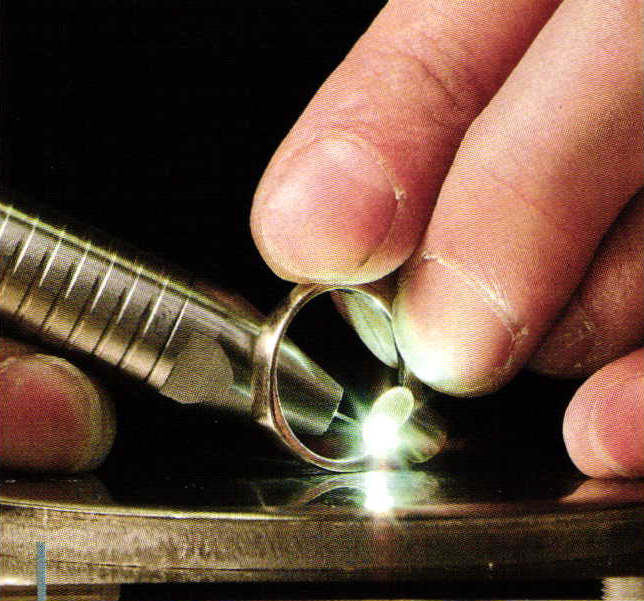
The earrings enterprise needs highly delicate methods for both manufacturing and restoration work. Traditional welding methods produce excessive temperatures that can damage gemstones and bend delicate metal frameworks. Laser spot welding enables jewelers to use a controlled technique for fixing precious jewelry items. Welders can join rings and necklaces and bracelets without damaging their adjacent decorative parts. The aesthetic appearance of weld seams stands as another benefit to jewelry processing from laser spot welding. The jewelry repair process requires only minimal polishing because the welding area exists in a compact size, which helps maintain the original design of the earrings.
Materials Suitable for Laser Spot Welding
Laser spot welding may be used on a extensive variety of metals which can be commonlyfound in commercial and ornamental items. The metals used in these applications include stainless steel and carbon steel and aluminum and titanium and gold and silver and various other valuable metals.
The capacity of laser spot welding to join different metals and precious materials makes it useful for multiple kinds of industrial applications. The technology serves multiple industries because its flexible nature enables various applications.

Conclusion
Laser spot welding has become a necessary method which produces accurate restoration results for multiple industrial fields including mold production and jewelry processing. Its cappotential to deliver precise heat through its localized heating system with minimal material distortion capacity establishes it as a superior option to many traditional welding techniques.
The process of laser spot welding enables manufacturers and craftsmen to extend the lifespan of their valuable resources through their untrained maintenance activities which protect product standards. The production sectors will continue to expand their implementation of laser spot welding technology as laser systems reach new development stages.


