
- All
- Product Name
- Product Keyword
- Product Model
- Product Summary
- Product Description
- Multi Field Search
Views: 0 Author: Site Editor Publish Time: 2026-07-02 Origin: Site


A laser welding machine helps you join things together very accurately. It uses a strong laser beam. You point the laser at the spot you want to weld. The laser’s heat melts the surfaces. This makes a small pool of melted material. When the pool cools down, the pieces stick together. Laser welding can make seams and joints that are thin or thick. It can also make them shallow or deep. You can use laser welding on metals and non-metals. It even works on materials that shine or reflect light.
Key features of laser welding:
You use heat to join parts together.
You can add filler materials or not.
Laser welding works with many kinds of materials.
Metric | Value (Year) | Growth Rate (CAGR) |
|---|---|---|
Global Market Value | USD 2.49 billion (2023) | 5.5% (2024-2032) |
Fiber Laser Segment Revenue | USD 1.3 billion (2025) | 4.2% (2026-2035) |
Electronics Segment Market Share | 32.4% (2025) | 6.9% (2026-2035) |
Laser welding machines use a strong laser beam to melt and join materials. This method gives very accurate and strong results. Safety is very important when using laser welding machines. Always wear safety gear and follow the setup steps closely. Laser welding works on metals like steel, aluminum, and titanium. It can also be used for plastics and ceramics. Conduction welding makes smooth and shallow welds. Keyhole welding makes deep and strong joints for thick materials. Laser welding is quick and saves energy. It also makes very little waste. This makes it great for car, airplane, and electronics industries.
A laser welding machine can join materials very accurately. First, you set up the machine carefully. You follow the instructions from the manufacturer. Safety is important. You wear special glasses and clothes to protect yourself. You also check that all safety systems work. Make sure your workspace is safe before you start.
Turn on the machine and let it get ready. Look at the control panel for any problems. You need to line up the laser beam with the welding spot. Check if the beam is strong and even. Set the machine’s power, pulse time, frequency, beam width, and spot size.
Clean the parts you want to weld. Put them in the right place. Use clamps or holders to keep them still. Move the laser’s focus to the welding spot. Test the beam on scrap pieces first. Point the laser at the start of the weld and move it slowly. The laser melts the surfaces and makes a small melted pool. When it cools, the pieces stick together. Let the part cool down after welding.
Here are the steps for laser welding:
Set up the machine by the instructions.
Wear safety gear and check safety systems.
Turn on the machine and check for problems.
Line up the laser beam with the weld spot.
Check the beam to make sure it is good.
Set the laser’s settings for your job.
Clean and place the parts you will weld.
Hold the parts with clamps or holders.
Move the focus and test the beam.
Start welding by aiming and moving the laser.
Let the welded part cool down.
You can weld many things like stainless steel, aluminum, copper, brass, carbon steel, and titanium. The thickness you can weld depends on the laser’s power. For example, a 500W laser can weld thin metals like aluminum and stainless steel from 0.5 to 1.0 mm. A 1500W laser can weld steel, aluminum, copper, and brass from 0.5 to 4.0 mm. Lasers with more power can weld thicker pieces.
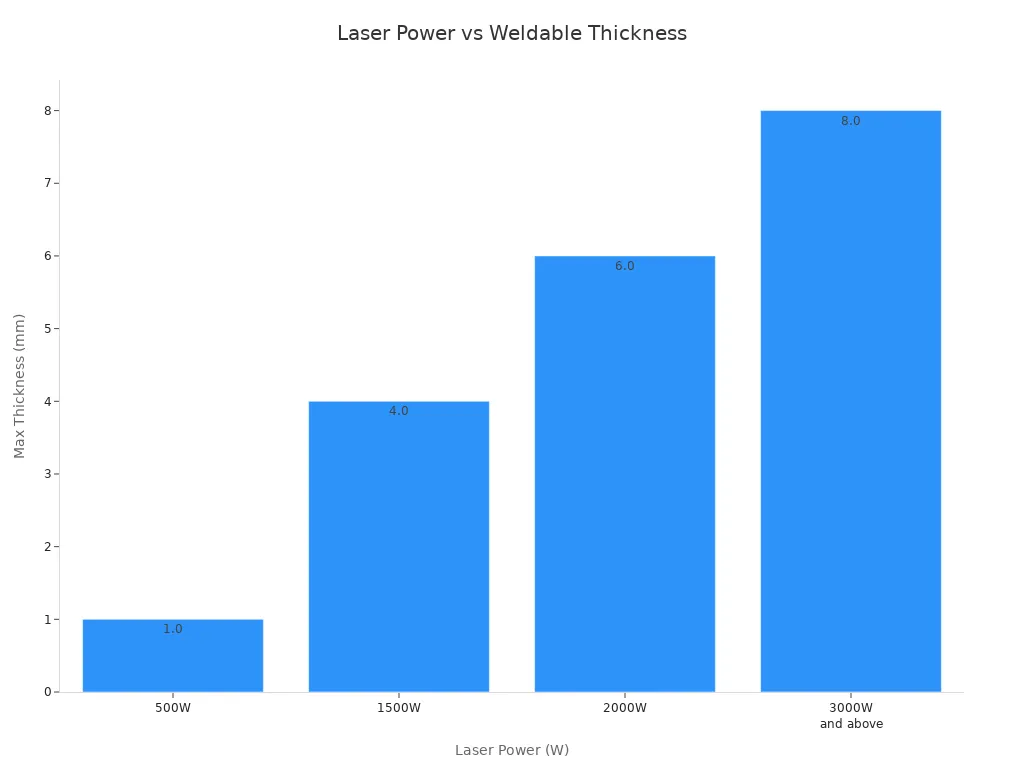
You can use fiber laser technology to weld metals like steel, aluminum, and titanium. Fiber lasers work at about 1070 nm. CO2 lasers are good for plastics and ceramics. Diode lasers are best for thin things or low-power jobs.
Laser welding is very exact and accurate. You can make welds with little bending or change. The process is quick and works well. You can join many types of materials. The laser does not touch the parts, so it is good for delicate things.
It is important to know the main parts of a laser welding machine. Each part has a special job. Here is a table that shows the main parts and what they do:
Component | Function |
|---|---|
Laser Source | Makes the strong laser beam for welding by changing electrical energy into laser light. |
Beam Delivery System | Sends the laser beam from the source to the welding head and keeps it focused and steady. |
Welding Head | Focuses the laser beam on the workpiece and controls the welding, including the shielding gas. |
Control System | Sets welding settings and gives feedback to keep welds good. |
Cooling System | Keeps parts cool so they do not get too hot and work well. |
You can use different lasers in your machine. Fiber laser technology is popular because it works well, is reliable, and is small. CO2 lasers make infrared light and are good for non-metal things. Diode lasers are efficient and do not cost much to run. Pick the laser type that fits your material and project.
Laser Type | Advantages |
|---|---|
Fiber Laser | Saves energy, works well, is small, and is good for welding metals like steel, aluminum, and titanium. |
CO2 Laser | Makes infrared light and is good for welding non-metal things like plastics and ceramics. |
Diode Laser | Efficient, does not cost much, and is good for welding thin things or low-power jobs. |
You can control the laser beam very well. The control system lets you change power, pulse time, and spot size. You can watch the weld quality as you work. The cooling system keeps the machine from getting too hot.
You need to take care of your machine often. Check the lens, clean the nozzle, look at the cooling system, and make sure cables are tight every day. Every week or month, clean or change lenses, check mirrors, clean the welding head, flush gas tubes, check chiller filters, and tighten parts. Every year, check electrical parts, change coolant, check temperature control, and update software.
Tip: You can add a laser welding machine to your production line easily. The controls are simple and easy to use. You can get good results and do less rework by controlling the welding settings well.
You must follow safety rules when using a laser welding machine. Wear laser safety glasses and protective clothes. Work in a room with good air and fire-safe walls. Follow health and safety rules and control dust and fumes.
You can learn to use a laser welding machine with training. Start with beginner lessons for setup and safety. Next, learn daily use and simple changes. Advanced lessons teach you how to adjust settings and make production better. You can get a certificate after passing tests.
Laser welding machines use new technology to give you high accuracy, speed, and many uses. You can weld many materials and thicknesses. Fiber laser technology is good for strong and reliable welding. You can get great results with careful setup, good care, and safe use.
Conduction welding is good for making wide, shallow welds. The laser uses less power in this method. Heat moves through the material by conduction. The weld looks like a bowl and is very smooth. This type works well for thin walls and when looks are important. People use it a lot for battery sealing. You can set up the machine for conduction welding without much trouble. The controls help you change power and spot size for better results. Many factories use conduction welding because it makes welds that look the same and need less fixing.
Main features of conduction welding:
Lower power density
Shallow, wide welds
Smooth surface finish
Good for thin materials
Keyhole welding uses a laser with a lot of power. The beam melts the material and makes a vapor channel called a "keyhole." This gives you deep and narrow welds. It is best for strong parts that need to hold together well. You can weld thick things like car parts. Keyhole welding is faster than conduction welding. It works well in factories where time is important. People use it for battery tabs and gearboxes.
Tip: Pick conduction welding if you want a nice look. Pick keyhole welding if you need deep welds.
Feature | Conduction Laser Welding | Keyhole Laser Welding |
|---|---|---|
Power Density | Lower power density, leading to shallow welds | High power density, leading to deep welds |
Weld Shape | Wider and shallower, often bowl-shaped | Deep and narrow, resembling a keyhole |
Melting Mechanism | Melting through heat conduction | Melting through vaporization |
Weld Depth | Few tenths to 1 mm | Much greater depths |
Applications | Thin-wall, aesthetic welds | Structural welds, deep penetration |
Common applications:
Conduction welding: battery sealing, parts with smooth surfaces
Keyhole welding: automotive power train, battery tab welding
Laser welding technology lets you pick the right way for your job. You can use conduction welding or keyhole welding. The machine lets you change settings for each one. You get good results and can use the machine in your factory easily.
Laser welding has many good points for your shop or factory. It is much faster than old welding ways. You can finish jobs quickly and save money. The welds look the same every time, so you get steady quality. You can weld thin or thick pieces. Deep penetration welding is possible too. Laser welding can join different metals, like steel and titanium.
Modern machines let you change all the settings. You can watch the weld as you work to check quality. The controls are easy to use. Even new users can get good results. You can add a laser welding machine to your line without problems. This helps you keep quality high and do less rework.
Laser welding uses less energy and makes fewer fumes. This is better for the earth and saves you money. You do not have to touch the parts, so they stay clean. You can weld from just one side, which helps in tight spots. There is little scrap and almost no bending of parts.
Benefit | Description |
|---|---|
Weld strength | Makes strong, narrow welds with great depth and width. |
Heat affected zone | Small heat zone, so nearby material does not get soft. |
Versatile material range | Can weld many metals like carbon steel, stainless steel, and titanium. |
Precision work | Good for tiny parts and small welds. |
Deformation | Parts do not bend or shrink much. |
Non-contact | The laser does not touch the part, so it stays clean. |
One sided welding | You can weld from one side, like spot welding. |
Scrap | Makes very little waste because you control the process. |
Tip: Laser welding machines can use up to 95% less energy. They also need less fixing. Companies say they spend 25% less on making things and work 35% faster.
You should know the hard parts of laser welding before you start. You must line up the parts very well. If you do not, the weld can be weak or bad. Joining different metals is hard because cracks or gaps can form. You must keep the gap very small, less than 0.1 mm, for good welds.
Laser welding machines cost a lot at first. You also pay for training and fixing the machine. You must follow safety rules. Wear special gear and use a safe cover to stop burns or eye harm. Safety is needed every day.
Laser welding is not good for very thick pieces. It is not as flexible as MIG or TIG welding. You need skilled people to run the machine. Taking care of the machine is hard. You must clean lenses, check the system, and change parts often. Shiny metals like copper and aluminum can cause trouble and hurt the machine.
Some problems are spatter, cracks, holes, undercut, gaps, and too much heat. You must watch for these to keep welds good. Joining different metals can cause special problems.
Aspect | Laser Welding | SMAW |
|---|---|---|
Energy Consumption | Uses less energy overall | Uses more energy for each weld |
Emissions | Makes very little smoke | Makes a lot of smoke |
Resource Consumption | Does not use up parts | Needs new electrodes |
Water Usage | Uses little water with closed cooling | Often needs water for cooling |
Lifetime Environmental Impact | Lower because it is efficient | Higher because it makes more waste |
Carbon Footprint | Cuts emissions by 30-45% | Makes more emissions |
Waste Management | Makes little waste or spatter | Makes more solid waste |
Note: Always check how parts fit and line up before welding. This helps you stop problems and keep welds the same.
Laser welding is used in many industries. It helps make products with strong and neat joints. Here are some examples of where it is used and why:
Car factories use laser welding for body panels, fuel tanks, and engine parts. This makes cars stronger and safer. Electric car makers use it too because they need to make many cars fast.
Airplane and defense companies use laser welding for light and strong parts. These parts must handle a lot of stress and help save fuel.
Electronics and communication companies use laser welding for small and tricky parts. This keeps devices tiny and helps them work well.
Medical device makers use laser welding for tools and implants. These must be very clean and safe for people.
Laser welding is also used in other places. Factories use it for heat exchangers, metal pipes, and plumbing. It helps make tight joints and stops leaks.
Tip: Laser welding lets you join many materials. You can weld plastics like PC, PA, ABS, and metals like steel and aluminum.
HND Laser is a top company for laser equipment. They have lots of research, many patents, and know a lot about lasers. You can count on them for special laser welding solutions.
There are different laser welding machines for different jobs. Each one has features that fit certain tasks. Here is a table to compare them:
Type of Laser Welding Machine | Distinguishing Features |
|---|---|
Fiber Laser Welding Machines | High-powered, precise beams using optical fibers; high electrical efficiency; minimal heat waste; best for high-volume production. |
CO₂ Laser Welding Machines | Uses carbon dioxide; good for thick metals and non-metals; deep penetration for special applications. |
Nd:YAG Laser Welding Machines | Uses a crystal called neodymium-doped yttrium aluminum garnet; works well for micro-welding; often used in pulsed mode. |
You can also get handheld and portable machines. Handheld machines help you weld big or hard-to-move parts. Portable machines let you weld in different places. For making lots of things, robots with lasers work fast and do the same job every time.
Laser welding is used for many products. You see it in car fuel rails, plane turbine blades, surgery tools, and heat exchanger parts. You can use laser welding for metals and plastics. This makes it a good choice for many jobs.
You can use a laser welding machine to join things fast. The laser beam is focused and makes strong, clean welds. It uses less heat, so there is less waste. You can weld thin or thick parts.
You can weld metals like steel, aluminum, copper, and titanium. Some machines can also weld plastics and ceramics. Always check your machine’s guide before you start.
Yes, laser welding is safe if you follow the rules. Wear safety glasses and special clothes. The controls are simple to use. Many factories teach new workers with easy lessons.
You set the welding settings on the control panel. Change the power, speed, and spot size. Try welding on scrap pieces first. Watch the weld as you work to keep it good.
HND Laser has a smart research team and many patents. They give you advanced laser solutions for welding, marking, and cutting. Their knowledge helps you pick the right machine for your job.


